Book 31: Loose Girl: A Memoir of Promiscuity, by Kerry Cohen
In the Acknowledgements section of the book, Cohen cites several memoirs as inspiration; two of them are ones I own, the other are on my to-be-read shelves.
Unfortunately, this book was not as good as the two I'd already read. Cohen goes into great detail of her sordid sexual encounters with men and how she used them to overcome the painful experiences of her childhood, including her mother abandoning the family to study medicine in Asia and her father's attempts to be more friend than parent.
The part where the book lacks, though, is the resolution. To hear Cohen tell it, she basically woke up one day and...got over things. There was no lengthy struggle, but rather simple an "Oh, well, maybe I shouldn't do this anymore."
A quick read, but not really recommended.
Sunday, July 17, 2011

Book 30: Reading the OED
The OED, or Oxford English Dictionary, is enormous. 21,730-pages-enormous, to be exact. Along the same vein as A.J. Jacobs's The Know-it-All, wherein Jacobs reads the entire Encyclopaedia Brittanica in a year, Shea takes one year to read the Oxford English Dictionary. The OED contains over 600,000 entires; its goal, when first published, was to include every word in the English language. Its goal was to eliminate:
- Incomplete coverage of obsolete words
- Inconsistent coverage of families of related words
- Incorrect dates for earliest use of words
- History of obsolete senses of words often omitted
- Inadequate distinction among synonyms
- Insufficient use of good illustrative quotations
- Space wasted on inappropriate or redundant content.
Unlike Jacobs's Know it All, though, Shea's book was less a tale of personal discovery and mostly a compilation of interesting words. Words like "unbepissed," meaning...not having been pissed on. Apparently not only did someone feel the need to come up with "bepissed," meaning "having been pissed on," but they also wanted to describe the state of not having been pissed on. Awesome?
Monday, July 4, 2011
Book 29: If You Can Read This
Book 29: If You Can Read This: The Philosophy of Bumper Stickers, by Jack Bowen
I need to learn to read book synopses more closely. I think I expected this one to be more like the psychology of people who apply bumper stickers or something. Instead, it was more along the lines of the Buffy and Philosophy book I read a while back.
The author takes various bumper stickers, like the formerly popular "Baby on Board!" and analyzes them according to various philosophical principles. In this case, Bowen comments that drivers are no more likely to NOT get into an accident with a car displaying this particular sticker than they are any other vehicle. He goes on to refer to the "action bias" - a person's inclination to believe that doing something is better than doing nothing, even if the "something" that they do makes things worse than the situation would have been had they done nothing.
By the end I found it difficult to pay attention to the full extent of the author's philosophizing about each sticker. I think changing the layout of the book would have been beneficial - rather than finish the section I was on, I felt myself inclined to skip forward to the next sticker as soon as I saw it.
Book 28: The Rhino with Glue-On Shoes
Book 28: The Rhino with Glue-On Shoes, and other surprising true stories of zoo vets and their patients, edited/compiled by Spelman and Mashima
It took me forever to get through this book - I seriously think I started it in, um, January, if not longer ago than that. Not because it was bad, but because each chapter is completely separate from the last, so there was no continuity, only the overarching theme of the trials and tribulations that zoo veterinarians face on a daily basis.
That being said, it wasn't a bad book. The stories were incredible - from the title story, literally about a rhinocerus who required special glue-on "rhino shoes" (akin to horse shoes) to help its feet recover, to the story of a woman who shipped her ordinary pet goldfish halfway across the country so it could undergo cancer treatment.
Saturday, June 25, 2011
Book 25-26 - A Feast for Crows
Book 25-26: A Feast for Crows, by George R.R. Martin
Oh, Martin. The first three books in your A Song of Ice and Fire series have been amazing. Brilliant characters, fascinating plots and sub plots and details that made my head sing, particularly upon re-reading.
But I don't think I will read A Feast for Crows again, unless you torture us by taking another five year hiatus between volumes.
The point-of-view characters I'd come to love are largely gone! Who are these new people, and why should I care about them? Where are Bran, Jon, and Tyrion? What's going on at the Wall, and Beyond? The POV characters we do get don't know, so neither do the readers.
This is not to say that the book does not have its good points - we learn more about certain characters and their motivations, and watch one in particular grow quite a bit over the latter half of the novel; I don't exactly like this person now, but I can understand his motivations more.
By the time the book was over, I wasn't even sure that I'd *read* the book before! (Now, Dianna, don't fret - you'll like the book - I just think I was unprepared for how different this book was from the first three. Not a bad different, just one I wasn't ready for).
How many more days until A Dance with Dragons is released, shipped, and at my door!?!?!? It can't come soon enough!!
Monday, June 6, 2011
Book #19: Waiting
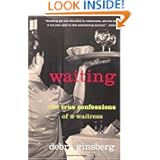
I'm starting to wonder how Ginsberg has any time to do the things she writes about - I realized halfway through this book that I'd read another book by her, titled Raising Blaze: A Mother and Son's Long, Strange Journey into Autism. In that book, she talks about how she reorganized her life around raising her son, who has autism but is more on the savant end of the scale.
In Waiting, Ginsberg talks about her time as a waitress, from learning the trade, fibbing to get into better gigs, and how great it is that it allows her to rearrange her schedule so she can write and raise her son. I began wondering how she had time to waitress if writing and child-rearing had her so busy; then how did she have time to write, if waitressing and her son were so time consuming! (She's also written another memoir about her family, particularly her sisters - is one person's life so interesting that it merits three memoirs before even celebrating her 50th birthday???)
Anyway, this book provides an inside look into the world of waitressing. It's got its funny moments, but generally is more about her experiences in particular than about waitressing in general. I guess I was disappointed by that, hoping for more of an anthropological look at the culture of waitresses, but it would also have helped if I'd realized I'd read something by this woman before. I'm not sure I'd recommend it - I'm sure there are blogs on the subject that are just as interesting, and much briefer reads.
Tuesday, May 31, 2011
Book #18: Grave Secrets
Kathy Reichs's novels are ones that I know Dianna holds dear; I've been working my way through them slooooowly, trying to avoid an OD like the one I gave myself when reading the Sookie Stackhouse books. This weekend I finished Grave Secrets as my 18th book of the year. (Interestingly enough, Charlaine Harris, who writes the Sookie books, also has a book titled Grave Secret!).
Anyway, I must say that I didn't enjoy this one as much as I've enjoyed the first four. I had a hard time following the plot - at least partially because I got distracted, wondering if Tempe was finally going to decide whether or not to pursue a relationship with her studcake detective friend, Andrew Ryan. As with Reichs's other novels, it was clearly well-researched, and even an only-had-one-physical-anthro-class-in-college gal like myself could follow along all the physical anthropology terms, even without consulting my husband!
In addition to reading this book over the weekend, Jeff and I also finished watching the most recent season of Bones. Every time I read one of these books, I can't help but think about how much better the books are than the shows - the Temperance Brennan character is much better in the books, much more believable; you get a better feeling for how long cases actually take in the books than on TV, etc. The finale of season 6? Gees. Don't get me started!!! :)
Subscribe to:
Posts (Atom)