Book 31: Loose Girl: A Memoir of Promiscuity, by Kerry Cohen
In the Acknowledgements section of the book, Cohen cites several memoirs as inspiration; two of them are ones I own, the other are on my to-be-read shelves.
Unfortunately, this book was not as good as the two I'd already read. Cohen goes into great detail of her sordid sexual encounters with men and how she used them to overcome the painful experiences of her childhood, including her mother abandoning the family to study medicine in Asia and her father's attempts to be more friend than parent.
The part where the book lacks, though, is the resolution. To hear Cohen tell it, she basically woke up one day and...got over things. There was no lengthy struggle, but rather simple an "Oh, well, maybe I shouldn't do this anymore."
A quick read, but not really recommended.
Showing posts with label steph 2011. Show all posts
Showing posts with label steph 2011. Show all posts
Sunday, July 17, 2011

Book 30: Reading the OED
The OED, or Oxford English Dictionary, is enormous. 21,730-pages-enormous, to be exact. Along the same vein as A.J. Jacobs's The Know-it-All, wherein Jacobs reads the entire Encyclopaedia Brittanica in a year, Shea takes one year to read the Oxford English Dictionary. The OED contains over 600,000 entires; its goal, when first published, was to include every word in the English language. Its goal was to eliminate:
- Incomplete coverage of obsolete words
- Inconsistent coverage of families of related words
- Incorrect dates for earliest use of words
- History of obsolete senses of words often omitted
- Inadequate distinction among synonyms
- Insufficient use of good illustrative quotations
- Space wasted on inappropriate or redundant content.
Unlike Jacobs's Know it All, though, Shea's book was less a tale of personal discovery and mostly a compilation of interesting words. Words like "unbepissed," meaning...not having been pissed on. Apparently not only did someone feel the need to come up with "bepissed," meaning "having been pissed on," but they also wanted to describe the state of not having been pissed on. Awesome?
Monday, July 4, 2011
Book 29: If You Can Read This
Book 29: If You Can Read This: The Philosophy of Bumper Stickers, by Jack Bowen
I need to learn to read book synopses more closely. I think I expected this one to be more like the psychology of people who apply bumper stickers or something. Instead, it was more along the lines of the Buffy and Philosophy book I read a while back.
The author takes various bumper stickers, like the formerly popular "Baby on Board!" and analyzes them according to various philosophical principles. In this case, Bowen comments that drivers are no more likely to NOT get into an accident with a car displaying this particular sticker than they are any other vehicle. He goes on to refer to the "action bias" - a person's inclination to believe that doing something is better than doing nothing, even if the "something" that they do makes things worse than the situation would have been had they done nothing.
By the end I found it difficult to pay attention to the full extent of the author's philosophizing about each sticker. I think changing the layout of the book would have been beneficial - rather than finish the section I was on, I felt myself inclined to skip forward to the next sticker as soon as I saw it.
Book 28: The Rhino with Glue-On Shoes
Book 28: The Rhino with Glue-On Shoes, and other surprising true stories of zoo vets and their patients, edited/compiled by Spelman and Mashima
It took me forever to get through this book - I seriously think I started it in, um, January, if not longer ago than that. Not because it was bad, but because each chapter is completely separate from the last, so there was no continuity, only the overarching theme of the trials and tribulations that zoo veterinarians face on a daily basis.
That being said, it wasn't a bad book. The stories were incredible - from the title story, literally about a rhinocerus who required special glue-on "rhino shoes" (akin to horse shoes) to help its feet recover, to the story of a woman who shipped her ordinary pet goldfish halfway across the country so it could undergo cancer treatment.
Saturday, June 25, 2011
Book 25-26 - A Feast for Crows
Book 25-26: A Feast for Crows, by George R.R. Martin
Oh, Martin. The first three books in your A Song of Ice and Fire series have been amazing. Brilliant characters, fascinating plots and sub plots and details that made my head sing, particularly upon re-reading.
But I don't think I will read A Feast for Crows again, unless you torture us by taking another five year hiatus between volumes.
The point-of-view characters I'd come to love are largely gone! Who are these new people, and why should I care about them? Where are Bran, Jon, and Tyrion? What's going on at the Wall, and Beyond? The POV characters we do get don't know, so neither do the readers.
This is not to say that the book does not have its good points - we learn more about certain characters and their motivations, and watch one in particular grow quite a bit over the latter half of the novel; I don't exactly like this person now, but I can understand his motivations more.
By the time the book was over, I wasn't even sure that I'd *read* the book before! (Now, Dianna, don't fret - you'll like the book - I just think I was unprepared for how different this book was from the first three. Not a bad different, just one I wasn't ready for).
How many more days until A Dance with Dragons is released, shipped, and at my door!?!?!? It can't come soon enough!!
Monday, June 6, 2011
Book #19: Waiting
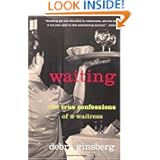
I'm starting to wonder how Ginsberg has any time to do the things she writes about - I realized halfway through this book that I'd read another book by her, titled Raising Blaze: A Mother and Son's Long, Strange Journey into Autism. In that book, she talks about how she reorganized her life around raising her son, who has autism but is more on the savant end of the scale.
In Waiting, Ginsberg talks about her time as a waitress, from learning the trade, fibbing to get into better gigs, and how great it is that it allows her to rearrange her schedule so she can write and raise her son. I began wondering how she had time to waitress if writing and child-rearing had her so busy; then how did she have time to write, if waitressing and her son were so time consuming! (She's also written another memoir about her family, particularly her sisters - is one person's life so interesting that it merits three memoirs before even celebrating her 50th birthday???)
Anyway, this book provides an inside look into the world of waitressing. It's got its funny moments, but generally is more about her experiences in particular than about waitressing in general. I guess I was disappointed by that, hoping for more of an anthropological look at the culture of waitresses, but it would also have helped if I'd realized I'd read something by this woman before. I'm not sure I'd recommend it - I'm sure there are blogs on the subject that are just as interesting, and much briefer reads.
Tuesday, May 31, 2011
Book #18: Grave Secrets
Kathy Reichs's novels are ones that I know Dianna holds dear; I've been working my way through them slooooowly, trying to avoid an OD like the one I gave myself when reading the Sookie Stackhouse books. This weekend I finished Grave Secrets as my 18th book of the year. (Interestingly enough, Charlaine Harris, who writes the Sookie books, also has a book titled Grave Secret!).
Anyway, I must say that I didn't enjoy this one as much as I've enjoyed the first four. I had a hard time following the plot - at least partially because I got distracted, wondering if Tempe was finally going to decide whether or not to pursue a relationship with her studcake detective friend, Andrew Ryan. As with Reichs's other novels, it was clearly well-researched, and even an only-had-one-physical-anthro-class-in-college gal like myself could follow along all the physical anthropology terms, even without consulting my husband!
In addition to reading this book over the weekend, Jeff and I also finished watching the most recent season of Bones. Every time I read one of these books, I can't help but think about how much better the books are than the shows - the Temperance Brennan character is much better in the books, much more believable; you get a better feeling for how long cases actually take in the books than on TV, etc. The finale of season 6? Gees. Don't get me started!!! :)
Saturday, May 28, 2011
Book #17: The Red Leather Diary
I skipped posting a blog about number 16, because it was me re-reading George R.R. Martin's A Clash of Kings, and I wasn't sure you needed to hear me gush about it - though I am now trying to track down a hardcover copy, as the spine of my paperback's cracked (hate when that happens, but it my defense, the books over 900 pages long!).
Number 17 for me was Lily Koppel's The Red Leather Diary: Reclaiming a Life Through the Pages of a Lost Journal.
Koppel, a journalist for the New York Times, is leaving her apartment building in New York City one morning when she comes across a treasure trove - stacks of old, 1930s era steamer trunks. Despite already being late for work, Koppel dives in, and ends up over her head in relics - flapper dresses and old lingerie, fur coats and family heirlooms... and, perhaps most intriguing, the red leather diary that gives the book its name.
Through some old fashioned detective work, she (and a real private eye!) track down the diary's owner, Florence. The book transports you through the woman's life, as recorded in the diary from 1929 through 1934.
I read this one in less than a day - I felt myself drawn back every time I attempted to put it down, something I've felt few times from books this year. The candor with which Florence details her life, including the sexual relationships she has with women (under her parents' roof!) was captivating.
Highly recommended to anyone who enjoys memoir, the era of the 1930s, or old New York City.
Wednesday, May 18, 2011
Book #15: Adam's Navel

Another one I didn't quite finish! I'm such a loser about books lately, I swear. This one started out so well, too. The book relates anecdotes about cultural views about the human body, how it functions, and how we should react to it. I think that I ran out of steam for reading it because while the facts were interesting, they weren't really tied together in any way, so I kind of lost interest.
It would probably be a good starting point if you were doing research about cultural attitudes? Maybe. I don't know. Or maybe just a few chapters at a time. Probably that. :)
Wednesday, May 4, 2011
Book #14: Deer Hunting with Jesus
Book #14: Deer Hunting with Jesus
I'm not sure what exactly I expected from Joe Bageant's Deer Hunting with Jesus: Dispatches from America's Class War. Maybe I expected some even-handedness? A realistic portrayal of life in the poor, Republican south? Instead, the book features a handful of lengthy essays in which Bageant bad-mouths anyone poor who isn't pro-union and anti-conservative. He claims that Republicans, the religious, and corporations are keeping people down in a desperate attempt to maintain class lines in the United States.
And we're supposed to believe Bageant, of course, because he grew up in West Virginia and was one of the "lucky few" to make it out.
His opinions are, at times, downright offensive. Calling the military a "de facto draft," for example, really didn't sit well with me. I'm not really sure I got anything out of this book, but for the spirit of finishing what I start, I did finish the whole thing. Somehow.
Book #13: Comfortably Numb
Book #13: Comfortably Numb
My 13th (oooooh, unlucky!?) book of the year was Comfortably Numb: How Psychiatry is Medicating a Nation, by Charles Barber. I'm not sure I have too much to say about this one. The title was kind of misleading. A better title would have been Comfortably Numb: Wherein Charles Barber Cites a Bunch of Studies that say Anti-depressants are Bad for You. As an English major, I was taught to use as many quotes as possible to prove a point; in the political science department, however, this was frowned upon. Apparently Mr. Barber took classes in my college's English department, because the whole book was citations (amounting to 35 pages of notes in the back) to attempt to prove his point that anti-depressants are bad for people with "depression-with-a-small-d" but might be okay for people with "Depression, capitalized."
As with most non-fiction books, most of the book presented the problem (over-medication) and the ending presented the solution. Barber sees the solution to the woes of America in Cognitive Behavioral Therapy, or CBT. He points a lot of blame at health insurance companies more interested in saving money than actually helping people. While that's likely true, there's just as much blame in the people accepting the medication - having been through many months of unsuccessful CBT, I can say that a lot of effort is required to go through it successfully. You can get more out of two sessions if you're motivated than you'll ever get out of 20 if you're not willing to put in effort.
Saturday, April 23, 2011
Book #12: A Game of Thrones

My 12th book for this year was A Game of Thrones, the first in the Song of Ice and Fire series by George R.R. Martin. I started re-reading it in anticipation of the amaaaaaaaaaazing new series on HBO by the same name.
I've read this book before, a few times, and will likely read it again, a few times. The book has only improved each time I've read it, and how many books can say that? (I bet Dianna would say so about her beloved Harry Potter series!). Furthermore, this is the first time I've read it since having earned a degree in English literature - and while I won't say the degree has gotten me much (if any) benefit, it did help me get more enjoyment out of the book. The symbolism and foreshadowing popped out at me this time.
Enough gushing. To provide a simple summary, the plot of the book is summed up by its title - kings and lords and knights play, effectively, a "game of thrones" to see who is really going to rule the land...while each and every family involved ignores what is, perhaps, a more serious threat that is looming over all of them. Considered epic fantasy, the books contain less magic and more knights and courtly intrigue.
The first episode of the TV show based on this series aired on Sunday, April 16th (yes, I consider it a birthday present to myself!!!) and essentially covered the first 70 pages of this novel. The people I've talked to who've seen the show but not read the book(s) found it sort of confusing, but with how much exposition is in this book (it's over 700 pages long!), that's kind of not surprising. I was truly taken aback by how faithful the first episode was to those first 70 pages, save a handful of changes that had to be made, likely for legal reasons. I hope the next 9 episodes, and the second season (which has already been ordered!) are just as magnificent.
I will likely be re-reading the other three books in this series over the next few months, as the fifth book comes out in July...and I've already pre-ordered it. :)
Saturday, March 19, 2011
Book #11: Switching Time
Book 11: Switching Time: A Doctor's Harrowing Story of Treating a Woman with 17 Personalities, by Dr. Richard Baer
Another book where the title/sub-title pretty much sum up the plot, this was the memoir of a psychiatrist who, over the course of 16 years, treats a woman with a true case of multiple personality disorder.
Spawned as a coping mechanism to deal with a cycle of abuse that started well before she was born, "Karen's" MPD helped her get through years of abuse - from her father punching her mother's stomach while she was pregnant to ritualistic quasi-religious physical and sexual abuse. The journey is definitely interesting to follow as we watch Karen learn of her "alters" and eventually cope with having them.
Perhaps something fiction next...
Thursday, March 17, 2011
Book 10: The Mirror Effect
Book 10: The Mirror Effect: How Celebrity Narcissism is Seducing America, by Dr. Drew Pinsky and Dr. S. Mark Young.
Oh Dr. Drew. So handsome. Killer blue eyes. An engaging speaker, that time Jeff and I got front-row seats (!) at Chico State. Le sigh.
But oh Dr. Drew, your books. They're not good. I read another of his books, Cracked, about his experiences working as a physician in rehabs. That one wasn't good, and this was a disappointment, too. The book, at 267 pages, could have been half as long and still gotten its point across. The first 100+ pages were spent presenting the problem of "celebrity narcissism" - as if it really takes 100 pages to tell people that celebrities are narcissists, and to explain what narcissism actually is.
The book is based on a study that Drs. Pinsky and Young did where they had celebrities take the Narcissistic Personality Inventory. Predictably, celebrities score notably higher on the NPI than "average" people. Drew outlines causes for this and the consequences for today's youth.
I think I'd have been better off reading the scientific paper rather than this book. At least Drew's handsome on the cover:
Saturday, March 12, 2011
Book 9: Confessions of a Tax Collector
I think I've fallen a little behind in my quest to read 52 books this year. It didn't help that I started a few duds. :(
Anyway, this time I read Confessions of a Tax Collector: One Man's Tour of Duty Inside the IRS, by Richard Yancey.
The title pretty much spells out what the book is all about: a guy, adrift in his own life, takes a job as a Revenue Officer with the IRS. A former theater employee with an English degree and a fiance who won't actually commit to him, Yancey takes the job to prove to himself that he can commit to something and see it through. Along the way we learn of the way he changes lives - his own and that of delinquent taxpayers in Florida.
I can't really discuss too much more about the book without giving away how it ends, I suppose, so I'll leave it at that. It was an interesting read; I enjoyed Yancey's writing style as well as the look the book gave me into a world I am only peripherally familiar with.
Sunday, February 13, 2011
Book 8: Sex, Drugs and Cocoa Puffs
Book 8: Sex, Drugs and Cocoa Puffs, by Chuck Klosterman
An analysis of "low culture," Sex, Drugs and Cocoa Puffs: A Low Culture Manifesto by Chuck Klosterman made me chuckle off and on all the way through. Klosterman manages to apply the types of analysis that were discussed in my literature classes to a variety of topics throughout its essays. Topics included the mascots of kid's breakfast cereals, why people younger than Generation X don't really like Star Wars all that much (which I totally agreed with), and an analysis of Boston Celtics fans vs. Los Angeles Lakers fans.
I enjoyed this book quite a bit. His one-liners are pretty funny and there were several parts throughout the book where I literally said "Huh! Well, that makes sense" out loud... then I had to explain why I'd just said that to Jeff, who didn't always agree with me but that's just because he enjoys being frustrating.
Anyway, overall, I'd recommend it. I've already loaned it out to a fellow English degree holder because I thought she'd appreciate it. I had a professor who seemed like they were trying to pull off this kind of analysis (applying academic-type themes to everyday culture in an attempt to make said concepts more accessible), but Klosterman actually gets there while the professor didn't really succeed.
Saturday, February 5, 2011
Book 6: Pornified, by Pamela Paul
Book 6: Pornified, by Pamela Paul
The subtitle of this book, "How Pornography is Damaging our Lives, our Relationships, and our Families," should have tipped me off that this book was going to be full of terrible biases, but unfortunately it did not. Ms. Paul based her book on extreme examples of porn "users" - men in stereotypically antisocial professions who viewed pornography for 5 or more hours a week - a long time to be jerking off in front of a computer. Or so says my husband, who used to work for a porn store, and thus my most accessible "authority" on the topic. Also male, so that must count for something, too.
Anyway, Paul goes on to suggest that watching porn will lead you to neglect your family, become deeply interested in worse and worse pornography, until you find yourself masturbating to child porn and contemplating molesting your young female family members. She seems to make no appreciable discernment between pornography involving such activities as simulated rape, golden showers, and double penetration from more "softcore," two-person male-and-female pornography. She interchanges the words "porn" and "cybersex," not appreciating what seems to be a clear distinction between looking at pictures/watching videos online and actually participating in cybersex, where one (or more?) other people are involved.
Ultimately, Paul seems to suggest that the Internet be censored in the United States, since other countries cannot be trusted to hold the same standards as we do.
Awesome.
I have another book she's written, called The Starter Marriage and the Future of Matrimony . I'm now hesitant to read it, to be honest, since this book is SO extreme in its definition of "feminism."
The subtitle of this book, "How Pornography is Damaging our Lives, our Relationships, and our Families," should have tipped me off that this book was going to be full of terrible biases, but unfortunately it did not. Ms. Paul based her book on extreme examples of porn "users" - men in stereotypically antisocial professions who viewed pornography for 5 or more hours a week - a long time to be jerking off in front of a computer. Or so says my husband, who used to work for a porn store, and thus my most accessible "authority" on the topic. Also male, so that must count for something, too.
Anyway, Paul goes on to suggest that watching porn will lead you to neglect your family, become deeply interested in worse and worse pornography, until you find yourself masturbating to child porn and contemplating molesting your young female family members. She seems to make no appreciable discernment between pornography involving such activities as simulated rape, golden showers, and double penetration from more "softcore," two-person male-and-female pornography. She interchanges the words "porn" and "cybersex," not appreciating what seems to be a clear distinction between looking at pictures/watching videos online and actually participating in cybersex, where one (or more?) other people are involved.
Ultimately, Paul seems to suggest that the Internet be censored in the United States, since other countries cannot be trusted to hold the same standards as we do.
Awesome.
I have another book she's written, called The Starter Marriage and the Future of Matrimony
. I'm now hesitant to read it, to be honest, since this book is SO extreme in its definition of "feminism."
Saturday, January 22, 2011
Book 5: Once Upon a Quinceanera, by Julia Alvarez
Book 5 was Once Upon a Quinceanera, by Julia Alvarez .
Intended to be an examination of how the quinceanera celebration affects Latinas in our community, by the end, Alvarez loses track a bit and heads more into personal exploration.
Quinceaneras are the often very elaborate parties thrown for Latina girls for their 15th birthdays; think a Hispanic sweet sixteen. Various traditions, which started who-knows-where, include girls being dolled up in enormous white puffy gowns; girls' fathers exchanging the girls' flat shoes for heels; girls being crowned with tiaras; a 14 couple court to escort the girl into womanhood; and so forth. No one can seem to agree on where this tradition came from, but the purpose generally is to acknowledge the girls' statuses as "women" instead of "girls," marking their eligibility for marriage.
Alvarez explores what this really means in today's society. We no longer live in a world where girls get married at 15, yet this tradition says "you're a woman now, time to go be a grown up." There are no statistics directly relating "los quinces" to things like dropping out of high school or getting pregnant, but Alvarez does cite other studies that indicate that Latina girls in the US are generally in trouble - they drop out, have children, get involved with drugs, etc., at earlier ages than their white counterparts.
Overall, the book was alright. As I stated earlier, Alvarez lost sight of the quinceanera theme a bit by the end, instead focusing on her own troubles "at that age" and what might have been done for her as a Dominican-American. Although this does contribute to the theme of the book - the importance for Latino/a families to focus on helping their girls really fit into the expectations of American society while still maintaining an appreciation for their heritage - she doesn't really tie it in as nicely as one might expect from a published book.
Next book: Pornified, by Pamela Paul.
.Intended to be an examination of how the quinceanera celebration affects Latinas in our community, by the end, Alvarez loses track a bit and heads more into personal exploration.
Quinceaneras are the often very elaborate parties thrown for Latina girls for their 15th birthdays; think a Hispanic sweet sixteen. Various traditions, which started who-knows-where, include girls being dolled up in enormous white puffy gowns; girls' fathers exchanging the girls' flat shoes for heels; girls being crowned with tiaras; a 14 couple court to escort the girl into womanhood; and so forth. No one can seem to agree on where this tradition came from, but the purpose generally is to acknowledge the girls' statuses as "women" instead of "girls," marking their eligibility for marriage.
Alvarez explores what this really means in today's society. We no longer live in a world where girls get married at 15, yet this tradition says "you're a woman now, time to go be a grown up." There are no statistics directly relating "los quinces" to things like dropping out of high school or getting pregnant, but Alvarez does cite other studies that indicate that Latina girls in the US are generally in trouble - they drop out, have children, get involved with drugs, etc., at earlier ages than their white counterparts.
Overall, the book was alright. As I stated earlier, Alvarez lost sight of the quinceanera theme a bit by the end, instead focusing on her own troubles "at that age" and what might have been done for her as a Dominican-American. Although this does contribute to the theme of the book - the importance for Latino/a families to focus on helping their girls really fit into the expectations of American society while still maintaining an appreciation for their heritage - she doesn't really tie it in as nicely as one might expect from a published book.
Next book: Pornified, by Pamela Paul
.
Saturday, January 15, 2011
Book 4: Alice Sebond's The Almost Moon
Book Four was Alice Sebold's The Almost Moon. I enjoyed her first novel, The Lovely Bones (though I haven't seen the movie; I'm always afraid they won't live up to my expectations), and was moved by her memoir, Lucky, so it was a no-brainer to pick up The Almost Moon.
Sebold didn't disappoint. The story of an intense mother-daughter, love-hate relationship set in an area of Pennsylvania not all that far from my home town, I found it very easy to relate to some of the sentiments expressed by Helen, the main character. At one point she tells us:
The book's setting especially resonated with me when Helen mentions her family acquiring a quilt from an artisan at the Kutztown Fair, and when Jake, Helen's ex-husband, comments on how that area of Pennsylvania seems never to change, at one point commenting, "East Germany seemed cheerier than this."
Ultimately, it is a book of letting go and moving on. I find myself wanting to be able to do what Helen eventually does - to face the world, despite one's past, and move forward, accepting all consequences. I struggle with finding my own self, just as the character did.
Someday I hope I can do that.
Sebold didn't disappoint. The story of an intense mother-daughter, love-hate relationship set in an area of Pennsylvania not all that far from my home town, I found it very easy to relate to some of the sentiments expressed by Helen, the main character. At one point she tells us:
"In those moments, I would feel the cords of my upbringing pulling me back. I had not been raised to hug or to comfort or to become part of someone else's family. I had been raised to keep a distance. ... Judging Natalie as my mother had judged me was, I felt like telling her son, just my ass-backward way of showing love. I'd spent my life trying to translate that language, and now I realized I had come to speak it fluently. When was it that you realized the thread woven through your DNA carried the relationship deformities of your blood relatives as much as it did their diabetes or bone density?"
The book's setting especially resonated with me when Helen mentions her family acquiring a quilt from an artisan at the Kutztown Fair, and when Jake, Helen's ex-husband, comments on how that area of Pennsylvania seems never to change, at one point commenting, "East Germany seemed cheerier than this."
Ultimately, it is a book of letting go and moving on. I find myself wanting to be able to do what Helen eventually does - to face the world, despite one's past, and move forward, accepting all consequences. I struggle with finding my own self, just as the character did.
Someday I hope I can do that.
Tuesday, January 11, 2011
Book Three: The Immortal Life of Henrietta Lacks, by Rebecca Skloot
A product of a decade of research, Rebecca Skloot's The Immortal Life of Henrietta Lacks gives a face and family to the cells that many scientists and researchers commonly refer to as the HeLa cells.
Taken without Lacks's permission in the '40's, cells from a tumor on her cervix were the first that scientists were able to successfully culture in a lab. At the time, African Americans were fearful of "white man's medicine" - and rightfully so. At the same time as Lacks was being treated for a particularly nasty form of cervical cancer, researchers were purposefully infecting other blacks with syphilis - and not curing them - in order to study the "natural progression of the disease."
After Lacks's death, her family wasn't informed of what her cells were contributing to. When they were finally told that Henrietta's cells were still alive, they didn't understand what it all meant; their lack of education combined with the callousness of researchers led the family to believe that Henrietta had been cloned, that they were all going to get cancer - or that they were owed a LOT of money by Johns Hopkins Hospital.
A very interesting text on both the Lacks family and the field of bioethics, I recommend this one. Skloot's passion for telling the story - the truth, the whole truth (with one noted exception at the request of the family), and nothing but - is admirable and her desire to really get it right is to be praised.
By the end, I admit that I felt guilty for having acquired a used copy; proceeds from sales of the book go to benefit the Henrietta Lacks Foundation, an organization whose mission is providing scholarships or grants to cover medical treatment to members of the Lacks family or to those who "have made, or be the descendant of someone who has made, a significant contribution to scientific research as a research subject, including those who have unwillingly or unknowingly contributed biological materials for research."
Three down, 49 to go to reach my goal for the year!
Subscribe to:
Posts (Atom)